How to Fit a Sauna Into a Small Backyard
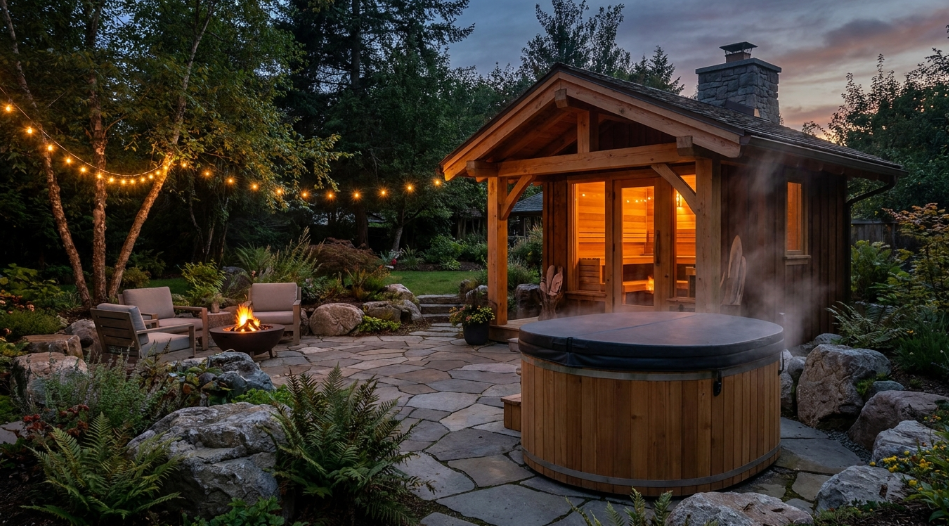
A one or two-person barrel or cabin sauna can fit into as little as 16 to 36 square feet, which is small enough for most side yards, a corner of a patio, or a strip of lawn along a fence line. The real constraints aren’t usually floor space, they’re clearance for the door to swing, electrical access, and local setback rules from your property line. Measure those three things first and the rest of the planning gets a lot easier.
Step 1: Measure What You Actually Have to Work With
Walk your yard with a tape measure before you look at a single product page. You need the footprint of the sauna itself, plus at least 24 to 30 inches of clearance around the door for it to open fully, and another couple of feet if you want a bench or towel hook outside. A two-person barrel sauna typically has an 6 to 7 foot diameter footprint, while a compact square cabin might be closer to 5 by 6 feet. Sketch the space on paper with actual measurements rather than eyeballing it. It’s the single step most people skip and the one that causes the most regret after delivery.
Step 2: Check Your Local Setback and Permit Rules
Most municipalities treat a small sauna as an accessory structure, similar to a shed, which usually means a required setback of 3 to 5 feet from rear and side property lines, sometimes more. Some cities exempt structures under a certain square footage from needing a building permit entirely, while still requiring an electrical permit if you’re hardwiring a heater above a standard outlet’s capacity. A five-minute call to your local building department before you order saves you from a sauna sitting in a driveway because it can’t legally go where you planned.
Step 3: Plan Your Power Before You Plan Your Layout
Compact infrared units often run on a standard 120-volt, 20-amp outlet, which makes them the easiest option if you don’t want an electrician involved. Larger traditional cabins with a 6 kW or bigger heater usually need a dedicated 240-volt circuit, which means running a new line from your panel, often at a cost of $500 to $1,500 depending on the distance and whether you need to break into a finished wall or slab. If your yard doesn’t already have exterior power, get a quote from an electrician before you fall in love with a specific unit, since the wiring cost can rival the price of the sauna itself.
Step 4: Pick a Footprint That Matches Your Space, Not Your Wish List
It’s tempting to size up “in case,” but a sauna that barely fits gets used less than one that fits comfortably. If your usable space is under 30 square feet, a one-person infrared cabin or a compact barrel model is the realistic choice, generally priced from $2,000 to $4,000. Between 30 and 50 square feet opens up two-person barrel and cabin saunas, typically $3,500 to $7,000. Above that, a traditional cedar cabin built for three or more people becomes viable, though few small-yard installs actually have room for one. When you’re comparing footprints against your measured space, a retailer like sweatdecks.com lists exact exterior dimensions for each model, which is more useful at this stage than a marketing photo that makes everything look bigger than it is.
Step 5: Prepare the Ground Before Delivery
A sauna needs a flat, stable, well-drained base. A concrete pad, paver base, or pressure-treated deck all work; bare lawn does not, since wood contact with soil invites rot and pests within a season or two. Gravel pads are a common budget option: excavate 4 to 6 inches, add a layer of landscape fabric, then compacted gravel, and you have a base that drains well and costs a fraction of poured concrete. Whatever base you choose, get it done and cured or settled before delivery day, since most units arrive on a pallet and installers won’t set a sauna on an unprepared surface.
Step 6: Think About Sightlines and Ventilation Together
Small yards mean your sauna is probably going to be visible from a neighbor’s window, a kitchen table, or the street, so it’s worth thinking about orientation before you commit to a spot. Angling the door away from a shared fence line buys some privacy without a fence upgrade. At the same time, don’t tuck the unit into a spot so tight that the exterior vents get blocked by a fence or wall, since airflow around the cabin matters almost as much as airflow inside it for heat dissipation and wood longevity.
Step 7: Budget for the Whole Job, Not Just the Sauna
The unit price is only part of the total cost. Add ground prep, which runs anywhere from a couple hundred dollars for a DIY gravel pad to $1,500 or more for a poured concrete slab done by a contractor. Add electrical work if you need a new circuit, typically $500 to $1,500. Add delivery, which some retailers include and others charge separately, especially for a heavier traditional cabin that needs more than two people to move off the truck. A sauna listed at $3,500 can easily become a $5,000 to $6,000 project once ground prep and power are factored in, and it’s better to know that number going in than to be surprised by it after the unit is already on order.
It’s also worth thinking about the shoulder seasons, not just summer. A small-yard sauna gets used year-round in most climates, which means the path from your back door to the cabin door matters. A few paving stones or a short gravel path keeps you from tracking mud in February, and it’s a lot cheaper to add before the unit arrives than to retrofit around it later.
Frequently Asked Questions
What is the smallest backyard sauna you can buy?
One-person barrel and cabin saunas fit in as little as 16 to 25 square feet, roughly the size of a large closet.
Do you need a permit for a backyard sauna?
It depends on your city and the unit’s size. Many plug-in cabins under 120 square feet skip a building permit, but hardwired electrical work often needs one regardless. Check with your local building department first.
How close to a fence or property line can a sauna sit?
Setback rules vary, but 3 to 5 feet from a rear property line is a common starting point for a small accessory structure. Confirm your local rule before finalizing placement.
Can a sauna go on a small deck or patio instead of the lawn?
Yes, as long as the deck can support the weight and there’s clearance for the door and ventilation. Most wood and composite decking handle it fine.
References
- “Benefits and risks of sauna bathing.” The American Journal of Medicine, 2001. https://pubmed.ncbi.nlm.nih.gov/11165553/
- “Does the Combination of Finnish Sauna Bathing and Other Lifestyle Factors Confer Additional Health Benefits? A Review of the Evidence.” Mayo Clinic Proceedings, 2023. https://pubmed.ncbi.nlm.nih.gov/37270272/
- “Clinical Effects of Regular Dry Sauna Bathing: A Systematic Review.” Evidence-Based Complementary and Alternative Medicine, 2018. https://pubmed.ncbi.nlm.nih.gov/29849692/
- National Fire Protection Association. https://www.nfpa.org/